
Construction Jobs in Canada Without Canadian Experience: Requirements & Application Tips
Are you looking for construction jobs in Canada without Canadian experience? You may not need to have worked on a Canadian construction site before to qualify for every position. Some employers consider applicants with transferable skills, relevant experience from another country or the ability to learn on the job.
Canada’s construction industry includes opportunities in general labour, site preparation, material handling, road construction, residential building and other areas. However, the requirements vary by employer, job duties, province and level of responsibility.
For international applicants, there is another important consideration: being qualified for a construction job and being legally authorized to work in Canada are two separate things. An employer may be willing to consider your application, but you must also meet the requirements of the relevant Canadian immigration or work-permit pathway.
This guide explains how to find construction jobs for newcomers in Canada, present foreign construction experience effectively, apply for entry-level positions and identify employers that may recruit candidates from outside Canada.
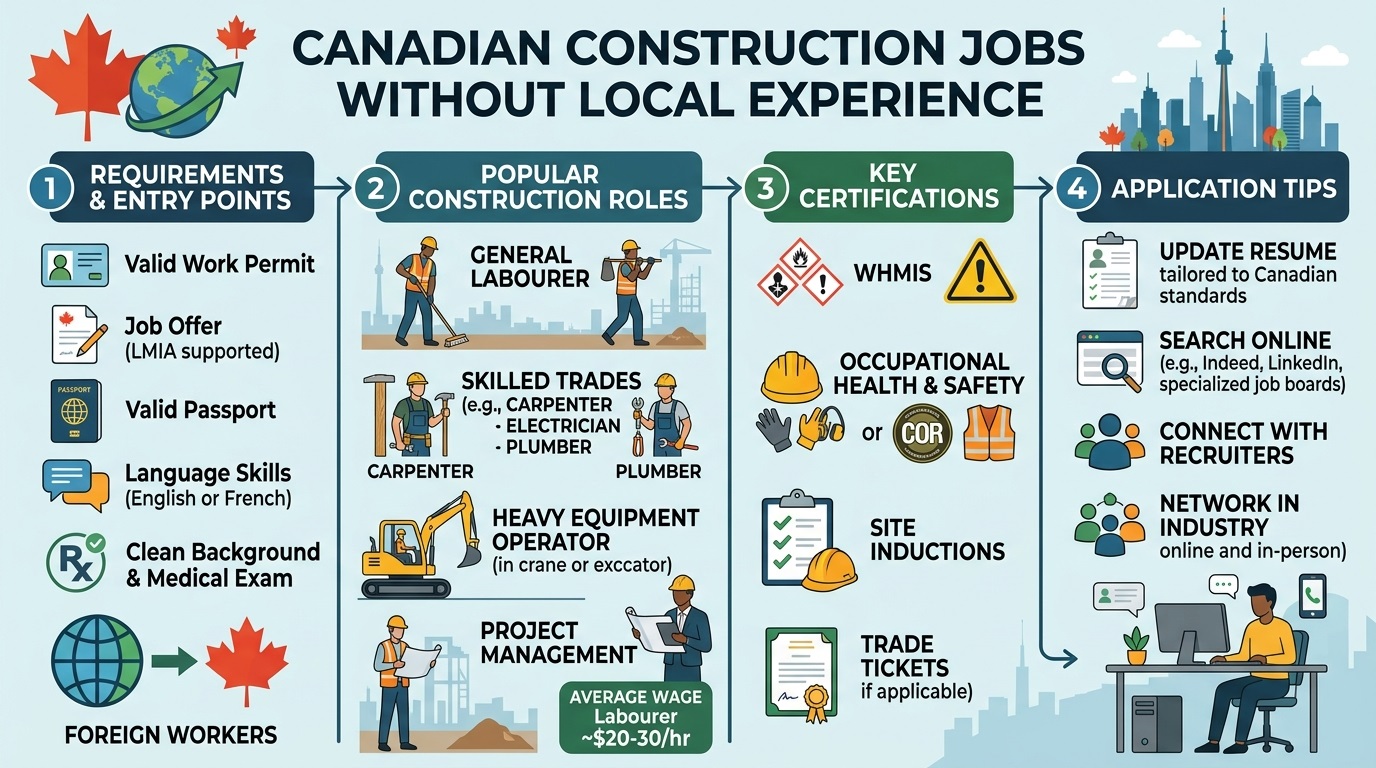
Can You Get Construction Jobs in Canada Without Canadian Experience?
Yes. Canadian experience is not a universal requirement for construction employment. Some positions focus on practical ability, reliability, physical fitness, safety awareness and willingness to learn rather than previous employment in Canada.
However, individual employers can require experience in a similar role, specific equipment skills, safety training or trade certification. For example, an entry-level construction labourer position may have different requirements from a carpenter, crane operator, electrician or construction supervisor.
According to Canada’s official Job Bank, some construction trades helpers and labourers may receive on-the-job training. Certain duties, such as traffic control or rigging, may require additional certification. Requirements depend on the specific occupation and work performed. Read the official Job Bank requirements.
It is useful to distinguish between three situations:
- No Canadian experience, but overseas experience: You have already worked in construction in Nigeria, Ghana, Kenya, South Africa or another country.
- No formal construction experience: You are applying for an entry-level role and can demonstrate transferable skills, physical readiness and a willingness to learn.
- Experienced tradesperson without Canadian certification: You have a skilled trade background but may need to verify whether your qualifications are recognized or whether licensing, apprenticeship registration or additional training is required.
Entry-Level Construction Jobs in Canada to Consider
If you have little or no construction experience, begin by researching roles whose listed requirements match your current abilities. Do not assume every entry-level vacancy accepts applicants without experience; read the individual advertisement carefully.
| Job title | Typical duties | What employers may look for |
|---|---|---|
| Construction labourer | Moving materials, cleaning work areas and assisting tradespeople | Physical readiness, reliability and safety awareness |
| Construction helper | Supporting carpenters, masons and other trades | Ability to follow instructions and use basic tools safely |
| Site cleanup worker | Removing debris and keeping work areas organized | Attention to safety and ability to perform physical tasks |
| Material handler | Moving, sorting and organizing construction supplies | Safe lifting practices and care when handling materials |
| Road construction labourer | Supporting roadwork crews and preparing work areas | Safety awareness and willingness to work outdoors |
| Landscaping construction labourer | Assisting with grading, site preparation and outdoor installations | Physical fitness and familiarity with outdoor work |
| Concrete labourer | Assisting with concrete placement, finishing and site preparation | Relevant experience may help; training and safety requirements vary |
These are examples of job categories to investigate, not confirmation that every employer is currently hiring or offers jobs to overseas applicants.
If you are new to the industry, search for terms such as “construction helper,” “general labourer,” “construction labourer,” “site cleanup worker” and “entry-level construction.” If you already have experience operating machinery, laying blocks, installing roofing, welding or performing carpentry, search for those specific skills instead of limiting yourself to general labour.
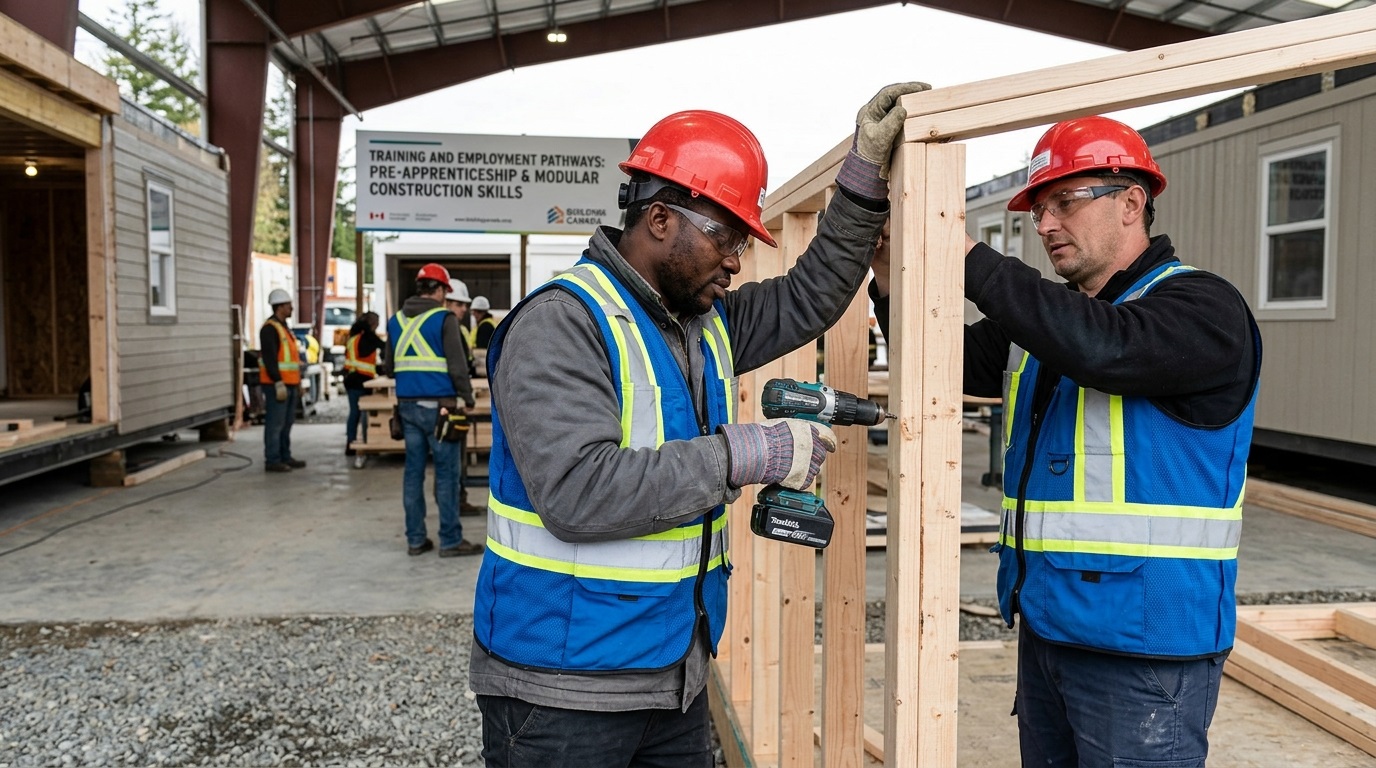
Do Canadian Employers Accept Foreign Construction Experience?
Foreign construction experience can be valuable. An employer may consider work completed outside Canada if it is relevant to the advertised duties and you can explain your responsibilities clearly.
For example, a candidate who worked on residential building projects overseas could describe experience with material handling, concrete preparation, masonry assistance, site safety or construction tools. Someone who worked on road projects could highlight site preparation, drainage, earthworks or equipment-related experience.
The important point is to show what you actually did rather than relying on a job title that may mean different things in different countries.
How to Present Your Overseas Experience
Prepare a résumé that includes:
- Your job title and the country where you worked.
- The names of previous employers or contractors, where appropriate.
- The types of construction projects you supported.
- The tools, machinery or building materials you worked with.
- Relevant safety training and certificates.
- The duration of your experience and your main responsibilities.
- References or employment documents you can provide if requested.
Where possible, quantify your responsibilities accurately. For example, you could explain that you assisted with residential construction, prepared materials for a crew or supported concrete work on a particular type of project. Do not claim to have operated machinery, held a licence or performed skilled work unless you genuinely have that experience.
If you have no previous construction employment, emphasize relevant practical experience, punctuality, teamwork, physical readiness, safety awareness and your ability to follow instructions. Be honest about your experience level.
Will Your Foreign Qualifications Be Accepted Automatically?
No. Recognition requirements depend on the occupation, the province or territory and the particular duties you intend to perform.
Many jobs are not regulated, but certain trades and activities may require certification, licensing, apprenticeship registration or employer-specific training. Canada’s foreign credential recognition guidance recommends checking the requirements for the intended occupation and location before beginning work.
Use the official Foreign Credential Recognition information and tools to investigate whether your qualifications need assessment.
Requirements for Construction Jobs in Canada
There is no single list of requirements that applies to every construction job. Employers establish role-specific requirements, while workplace safety and immigration rules apply separately.
1. Education
Some general labour positions may require little formal education, while skilled trades and technical positions can require secondary education, vocational training or an apprenticeship. Always check the advertised requirements.
2. Physical Ability and Reliability
Construction work can involve standing for long periods, lifting materials, working outdoors and following instructions in changing site conditions. Applicants should understand the physical demands before accepting a position.
3. Safety Training
Construction sites can present hazards involving tools, vehicles, heights, heavy materials and moving equipment. Employers may provide training or require particular safety courses, depending on the role and jurisdiction.
Never assume that a safety certificate from another country automatically satisfies Canadian requirements. Ask the employer or relevant provincial authority what training is accepted.
4. Language and Communication
You may need enough English or French to understand instructions, safety warnings and workplace procedures. The level required depends on the employer, the team and the job duties.
5. Trade Skills or Certification
Positions involving electrical work, plumbing, heavy equipment or other specialized tasks may have additional requirements. Before applying, check whether the occupation is regulated or whether the employer expects a recognized trade qualification.
6. Legal Authorization to Work
This is especially important for applicants outside Canada. A job offer by itself does not give you permission to begin working.
Depending on your circumstances, you may need an employer-specific work permit, an eligible open work permit or another valid basis for working in Canada. Eligibility depends on the relevant immigration rules and your individual situation.
Official starting points include Job Bank’s information for foreign candidates and Immigration, Refugees and Citizenship Canada.
How to Find Construction Jobs for Newcomers in Canada
Use official job platforms and employer career pages to identify opportunities that match your experience and work authorization.
1. Search Canada’s Official Job Bank
The Job Bank website allows you to search by occupation, employer, location and other criteria.
Useful search terms include:
- Construction labourer
- Construction helper
- General construction labourer
- Road construction labourer
- Concrete labourer
- Entry-level construction worker
If you are applying from outside Canada, start with Job Bank’s foreign-candidate page. It explains how to find postings aimed at international applicants and why you should check the eligibility information on each advertisement.
Job Bank also has a Temporary Foreign Workers section. It includes employers who have obtained or applied for a Labour Market Impact Assessment (LMIA). This can help you investigate opportunities, but the presence of a listing does not guarantee that a job remains available, that an LMIA will be approved or that you qualify for a work permit.
2. Search Employers’ Official Career Websites
You can also check the careers pages of construction companies and contractors. Examples of established companies to research include:
- PCL Construction: Review vacancies across construction and project operations.
- Aecon: Search for construction, infrastructure and project-related opportunities.
- Ledcor: Explore openings across construction and infrastructure activities.
These companies are examples of employers in the sector, not a verified list of companies currently recruiting overseas candidates without Canadian experience. Check the location, qualifications, work authorization requirements and application instructions for each vacancy.
3. Target the Right Type of Employer
Smaller contractors, residential builders, concrete companies, roadwork contractors and landscaping construction businesses may advertise different types of entry-level roles. Search by job title and location rather than assuming that every large construction company recruits foreign workers.
Prioritize vacancies that clearly describe the duties, pay, work location, qualifications and application process. If you are applying from overseas, look for explicit information about international applicants or ask the employer whether it considers candidates who require work authorization.
Do Construction Jobs in Canada Offer Visa Sponsorship?
Some Canadian employers recruit foreign workers through applicable immigration pathways, but not every construction employer offers this option.
In Canada, the term “visa sponsorship” is often used informally. In practice, the process may involve an employer applying for an LMIA where required, followed by the worker applying for the appropriate work permit. Some work permits are LMIA-exempt, but only when the relevant exemption and eligibility requirements are met.
An LMIA requested label means an application has been made; it does not mean the LMIA has been approved. Even an approved LMIA does not, by itself, guarantee that a foreign worker will receive a work permit.
Before relying on a vacancy, confirm:
- Whether the position is still open.
- Whether the employer considers applicants outside Canada.
- Whether the employer is willing and legally able to support the applicable hiring process.
- Whether the job and your circumstances meet the requirements of the relevant work-permit pathway.
- Whether any stated recruitment or processing costs are legitimate and permitted.
For current rules, consult the official Government of Canada Temporary Foreign Worker Program information and IRCC’s work-permit guidance.
Do not pay a recruiter simply because they promise a guaranteed construction job, LMIA or visa. Verify the employer and the recruitment arrangement independently, and be wary of requests for payment to a personal account.
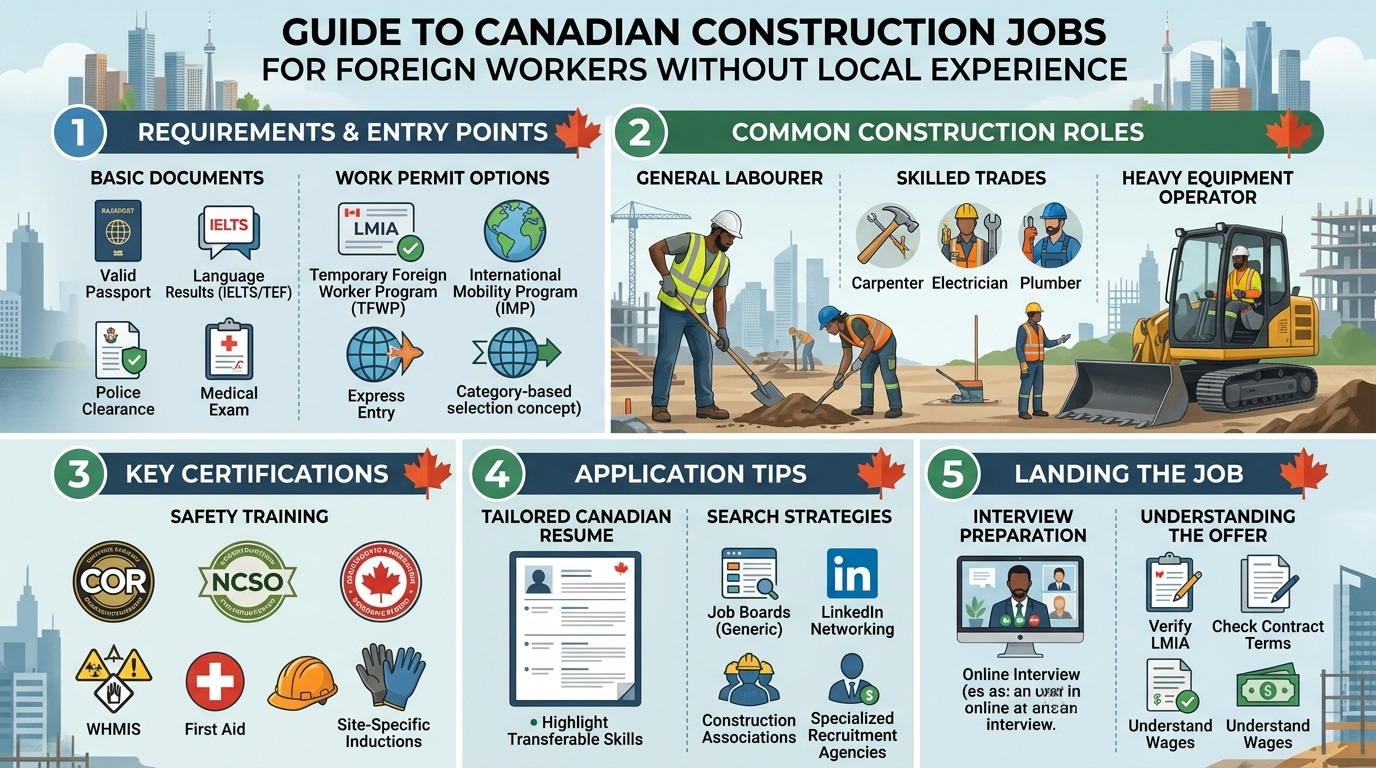
How to Apply for Construction Jobs in Canada Without Canadian Experience
Follow this process to make your application more relevant to Canadian employers.
Step 1: Choose a Realistic Job Category
Match your experience to the position. If you have never worked in construction, focus on genuinely entry-level vacancies. If you have overseas experience in masonry, concrete, carpentry, roofing or roadwork, search for roles that use those skills.
Step 2: Prepare a Canadian-Style Résumé
Keep your résumé clear and relevant. Include contact details, a short professional summary, work experience, practical skills, safety training and education. Adapt it to each job advertisement.
Do not invent Canadian work history or suggest that you already have work authorization if you do not.
Step 3: Gather Supporting Documents
Prepare available employment references, training certificates, trade qualifications and a record of your relevant duties. Provide translations when required. Do not send sensitive identity or financial documents to unverified recruiters.
Step 4: Read the Vacancy Carefully
Check the job location, wage, hours, duties, required experience, application deadline and work-permit conditions. A position that accepts candidates who already have Canadian work authorization may not be suitable for someone applying from abroad.
Step 5: Apply Through the Official Channel
Use the application instructions on the employer’s career page or the official job advertisement. Write a brief, specific application explaining how your experience matches the duties.
For overseas applicants, state your current location and work-authorization situation honestly. Ask whether the employer considers applicants who need a work permit where the advertisement does not make this clear.
Step 6: Prepare for an Interview
Be ready to discuss your previous tasks, tools used, safety practices, availability and ability to follow site instructions. If you are new to construction, explain your transferable skills without overstating your experience.
Step 7: Verify the Offer Before Making Travel Plans
Confirm the employer’s identity, the written employment terms and the immigration steps that apply to you. Do not resign from your current job, pay large sums or book travel based solely on a verbal promise.
Common Mistakes to Avoid
Applicants can waste time and money when they:
- Apply only to jobs requiring Canadian experience or qualifications they do not possess.
- Assume that every construction labourer vacancy is open to overseas applicants.
- Treat an LMIA request as an approved application.
- Claim to have Canadian certification when their foreign qualification has not been assessed.
- Send the same generic résumé to every employer.
- Pay someone who promises a guaranteed visa, job offer or permanent residence.
- Rely on an old vacancy without checking whether the employer is still recruiting.
A more effective approach is to match your skills to the actual duties, apply through verifiable channels and confirm immigration requirements before making major decisions.
Frequently Asked Questions
1. Can I get a construction job in Canada without Canadian work experience?
Yes, some positions do not require previous Canadian experience. However, employers may still require relevant overseas experience, training, safety certificates or other qualifications. The job advertisement determines the requirements for that position.
2. Can I apply for construction jobs in Canada from Nigeria?
You can search and apply for vacancies that consider international candidates. Whether an employer will hire you depends on the position, the employer’s recruitment needs and your ability to meet the relevant work-permit requirements. Applying does not guarantee an offer or permission to work.
3. Are there entry-level construction jobs in Canada for immigrants?
Yes, possible categories to investigate include construction labourer, construction helper, material handler and site cleanup worker. Requirements differ by employer, and people already living in Canada may have different work-authorization circumstances from applicants overseas.
4. Does Canadian construction experience matter more than foreign experience?
Not necessarily. Relevant foreign experience can demonstrate useful skills, but employers may also assess your knowledge of local safety procedures, tools, standards and job-specific requirements. Some roles may require Canadian training or certification.
5. Do construction labourer jobs in Canada require a degree?
Many general labour positions do not require a university degree. Some employers may require secondary education, relevant experience, safety training or other qualifications. Skilled and technical positions may have more demanding requirements.
6. Which Canadian construction companies sponsor foreign workers?
Do not assume that a company offers sponsorship simply because it operates in Canada or has a careers page. Check the individual vacancy and ask the employer whether it considers applicants who need work authorization. Job Bank’s Temporary Foreign Workers listings are one useful starting point, but each listing must be checked for current status and eligibility.
7. Can I get permanent residence through a construction job?
A construction job does not automatically lead to permanent residence. Eligibility depends on the immigration program, occupation, work experience, language ability and other applicable criteria. Review official IRCC requirements before making plans based on a possible future immigration pathway.
8. Is Canadian experience mandatory for every construction job?
No. Requirements vary by role and employer. Some employers consider applicants with relevant foreign experience or provide on-the-job training for suitable positions. Others require previous experience, local certification or specific qualifications.
Final Thoughts
Finding construction jobs in Canada without Canadian experience is possible, but success depends on choosing suitable vacancies and understanding the difference between job qualifications and immigration eligibility.
Start by identifying your strongest skills, preparing a targeted résumé and searching official job platforms. If you are applying from abroad, prioritize advertisements that consider international candidates and verify the employer’s work-permit process before spending money or making travel arrangements.
Use official sources, be honest about your experience and work authorization, and treat every job offer as something to verify rather than a guarantee of employment or immigration approval.