
Are you looking for construction labourer jobs in Canada as a foreign worker? Canada has employment opportunities in residential construction, commercial buildings, roadwork, infrastructure, excavation and other construction activities. Some employers advertise positions through Canada’s official Job Bank with a Labour Market Impact Assessment (LMIA) request, making these listings useful starting points for international job seekers.
However, not every construction labourer vacancy is open to applicants living outside Canada. Some employers only consider Canadian citizens, permanent residents and people who already hold valid Canadian work permits.
If you are applying from Nigeria, Ghana, Kenya, South Africa or another country, you need to understand the job requirements, identify employers that consider international candidates and establish which work permit process applies before making relocation plans.
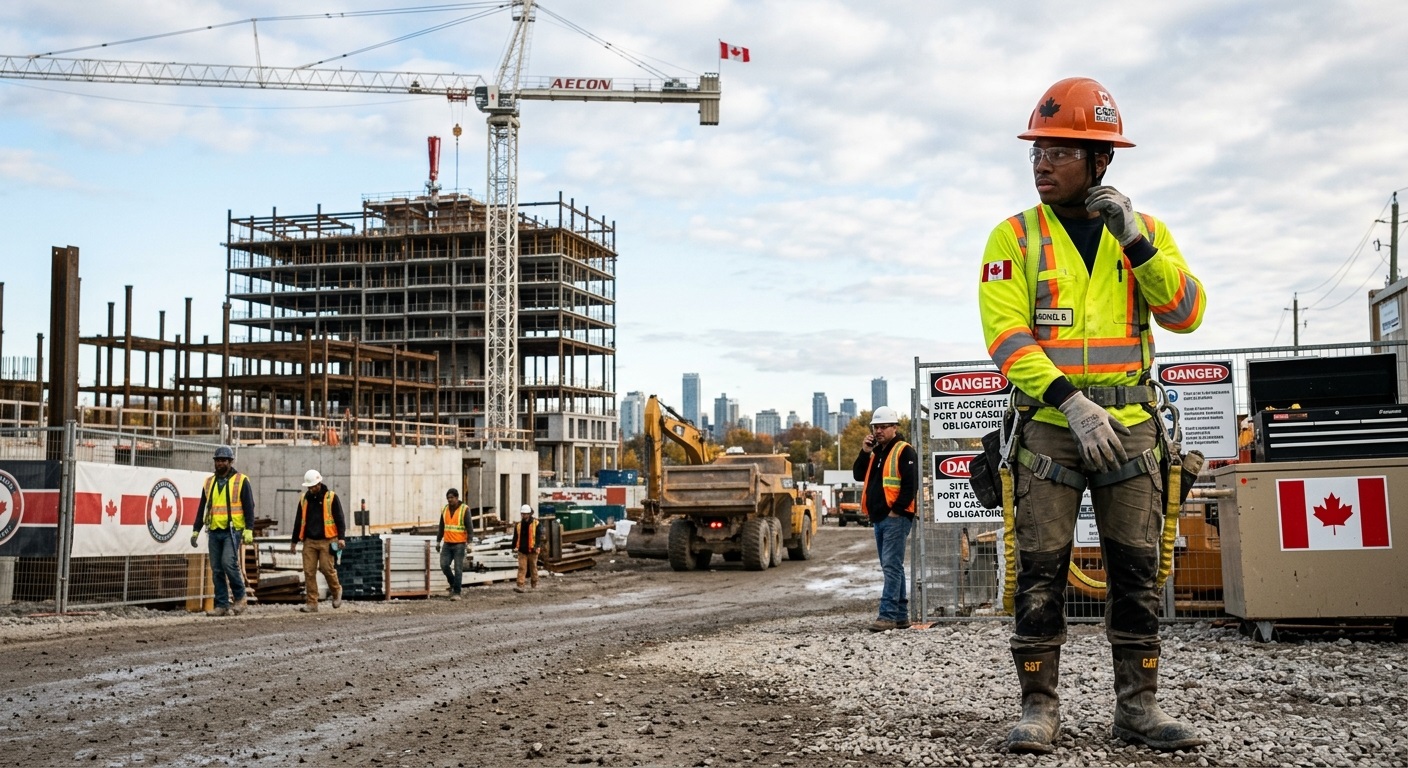
This guide explains the requirements for construction labourer jobs in Canada, where to find genuine vacancies, how to apply and how to avoid recruitment scams.
1. What Does a Construction Labourer Do in Canada?
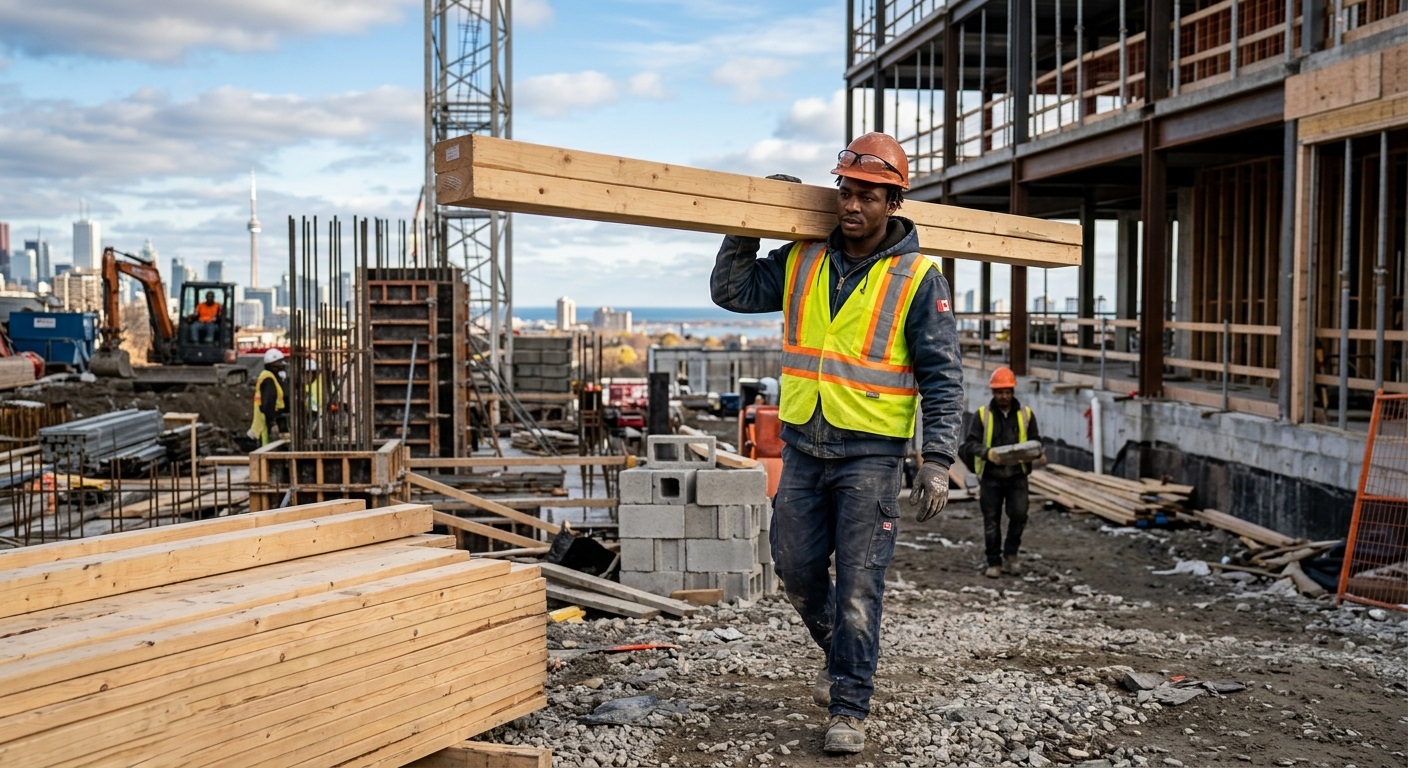
A construction labourer assists skilled tradespeople, contractors and site supervisors with general construction activities. The work may take place on residential building sites, commercial developments, roads, industrial facilities or infrastructure projects.
According to Canada’s National Occupational Classification, construction trades helpers and labourers are generally classified under NOC 75110.
Common duties include:
- Loading, unloading and transporting construction materials.
- Cleaning construction sites and removing debris.
- Mixing, pouring and spreading concrete or asphalt.
- Assisting with formwork, scaffolding and other temporary structures.
- Digging, levelling ground and preparing work areas.
- Helping carpenters, masons and other skilled tradespeople.
- Moving equipment and maintaining orderly work areas.
- Following site safety instructions and using appropriate protective equipment.
The exact responsibilities depend on the employer and project. Some jobs involve repetitive manual work, heavy lifting, outdoor conditions and exposure to dust, noise or changing weather.
Official reference: Canada Job Bank — Construction Worker Requirements.
2. Current Construction Labourer Vacancies to Investigate
Canada’s Job Bank provides listings from employers seeking workers, including some employers that have requested an LMIA to hire temporary foreign workers.
The following construction-related vacancies appeared in Job Bank’s search results when checked on October 17, 2026. They are useful leads, but their individual eligibility conditions must be checked before an applicant outside Canada submits an application.
| Job title | Employer | Location | Advertised pay | LMIA and overseas eligibility |
|---|---|---|---|---|
| Construction Labourer | NUNAVUT EXCAVATING | Iqaluit, Nunavut | CAD $29/hour | Listed as LMIA requested. The listing alone does not confirm that applicants living outside Canada will be considered. |
| Construction Labourer | Santerra Stonecraft | McGregor, Ontario | CAD $27/hour | Listed as LMIA requested. Confirm the current vacancy and applicant eligibility on the individual advertisement. |
| Construction Worker | Star Union Construction | Edmonton, Alberta | CAD $28/hour | Listed as LMIA requested. Confirm whether overseas applicants are eligible and whether the LMIA status has changed. |
Official vacancy links:
- NUNAVUT EXCAVATING — Construction Labourer
- Santerra Stonecraft — Construction Labourer
- Star Union Construction — Construction Worker
Important: These listings were identified through the current Job Bank search results, but their full vacancy pages could not all be independently reloaded during this research. Treat them as leads to verify, not as guaranteed open vacancies. The listed LMIA status means an LMIA was requested in the available search information; it does not establish approval or guarantee a work permit. Do not apply from overseas unless the individual listing accepts your circumstances or the employer confirms that it considers applicants who need work authorisation.
For more opportunities, use Job Bank’s Temporary Foreign Workers search. It is updated as employers post or remove vacancies.
How to check whether you can apply from abroad
Open the individual vacancy and locate the section titled “Who can apply for this job?”
Job Bank distinguishes between jobs open to international candidates and jobs restricted to Canadian citizens, permanent residents or people who already have valid work permits.
If the advertisement says not to apply unless you are already authorised to work in Canada, do not assume that its LMIA status overrides that restriction. Contact the employer through a verified channel to clarify whether it is recruiting new foreign workers.
3. Construction Labourer Requirements in Canada
Construction labourer requirements vary by employer, project and province. Many general labourer positions do not require a university degree, but employers may still expect relevant experience, physical capability, safety awareness and the ability to follow instructions.
Education
A high school diploma may be preferred by some employers, while other positions require no formal degree or diploma.
Read the vacancy carefully. Do not assume that every entry-level construction position has the same educational requirements.
Work experience
Some employers provide on-the-job training, while others expect previous construction experience.
Experience with material handling, site preparation, concrete work, demolition, excavation or general building tasks can strengthen an application.
If you have worked on construction projects in your home country, explain your actual duties and the equipment or materials you handled. Do not claim Canadian work experience you do not have.
Physical fitness and safety
Construction labouring can involve standing for long periods, repetitive movements, working outdoors and handling heavy materials. Employers may require workers to follow site-specific safety procedures and use protective equipment.
Certain duties, including operating specialised equipment, working at heights or performing regulated tasks, may require additional training or certification.
Language skills
Many Canadian construction sites require workers to understand instructions and communicate safety concerns. English or French requirements depend on the employer and work location.
You should be able to understand the job description and communicate adequately for the duties involved.
Licences and certifications
General labourers do not all need the same licences. However, some positions require credentials such as traffic-control training, rigging certification, equipment-operation qualifications or construction safety training.
Requirements may differ by province and occupation. Check the applicable rules before paying for a course or certificate.
Official reference: Job Bank — Construction Worker Employment Requirements.
4. Can Foreign Workers Get Entry-Level Construction Jobs in Canada?
Yes, some foreign workers may qualify for construction employment, including certain entry-level positions. However, being qualified for the job and being legally eligible to work in Canada are two separate requirements.
An employer may be willing to consider an applicant’s skills but still be unable to hire that person unless the applicable immigration requirements are met.
There are three important situations to understand.
Situation 1: The employer accepts international applicants and can use an applicable work permit route.
This is the type of opportunity to investigate if you are applying from outside Canada. Ask the employer which work authorisation process applies and what documents it can provide.
Situation 2: The employer has requested an LMIA.
This indicates that the employer has applied for an assessment under the Temporary Foreign Worker Program. The application may still be under review. It is not equivalent to an approved LMIA or an approved work permit.
Situation 3: The employer only accepts applicants who already have Canadian work authorisation.
You generally should not apply if you cannot meet the advertised eligibility conditions. A job listing can appear in a construction or LMIA-related search without offering a practical route for someone who has not yet obtained permission to work in Canada.
For international applicants, start with Job Bank’s Foreign Candidates from Outside Canada resource. It explains how to identify employers recruiting international candidates.
5. Understanding LMIA Construction Jobs in Canada
A Labour Market Impact Assessment, or LMIA, is an assessment used in Canada’s Temporary Foreign Worker Program. It considers whether an employer can hire a temporary foreign worker under the applicable programme requirements.
Where an LMIA is required, the employer generally needs a positive decision before the worker can use it to support an employer-specific work permit application.
The usual process is:
- The employer identifies a hiring need. The employer defines the job, wage, duties and qualifications.
- The employer completes the required process. Where an LMIA is required, the employer applies and meets the applicable conditions.
- The employer receives a decision. A requested LMIA may be pending, approved or refused.
- The worker applies for a work permit if required. The worker submits the appropriate application and supporting documents.
- The application is assessed. The worker must meet the relevant immigration requirements before beginning employment.
Not all work permits require an LMIA. The correct route depends on the person’s circumstances, the job and the applicable immigration programme.
Who pays the LMIA fee?
The employer is responsible for the LMIA processing fee where one applies. It cannot recover that fee from the temporary foreign worker.
Be cautious if a recruiter asks you to purchase an LMIA, pay for a guaranteed job offer or send money to secure a Canadian work permit.
Read the Government of Canada — Temporary Foreign Worker Program and IRCC — Employer-specific work permits.
6. How Much Do Construction Labourers Earn in Canada?
Construction labourer wages vary according to the province, employer, project, experience, work schedule and type of duties.
A vacancy’s advertised hourly wage is not a guarantee of annual earnings. The amount you receive depends on paid hours, overtime arrangements, deductions, benefits and employment conditions.
When comparing opportunities, examine:
- The hourly wage and expected hours per week.
- Whether employment is permanent, seasonal or contract-based.
- Whether overtime is available and how it is paid.
- Whether accommodation, transport or relocation assistance is included in writing.
- The cost of living in the job location.
- Any required tools, protective equipment or certifications.
Do not select a job based on the advertised wage alone. A higher hourly rate may come with demanding conditions, a remote work location or additional costs.
You can investigate wage information through Canada Job Bank’s construction occupation resources.
7. How to Apply for Construction Labourer Jobs in Canada From Abroad
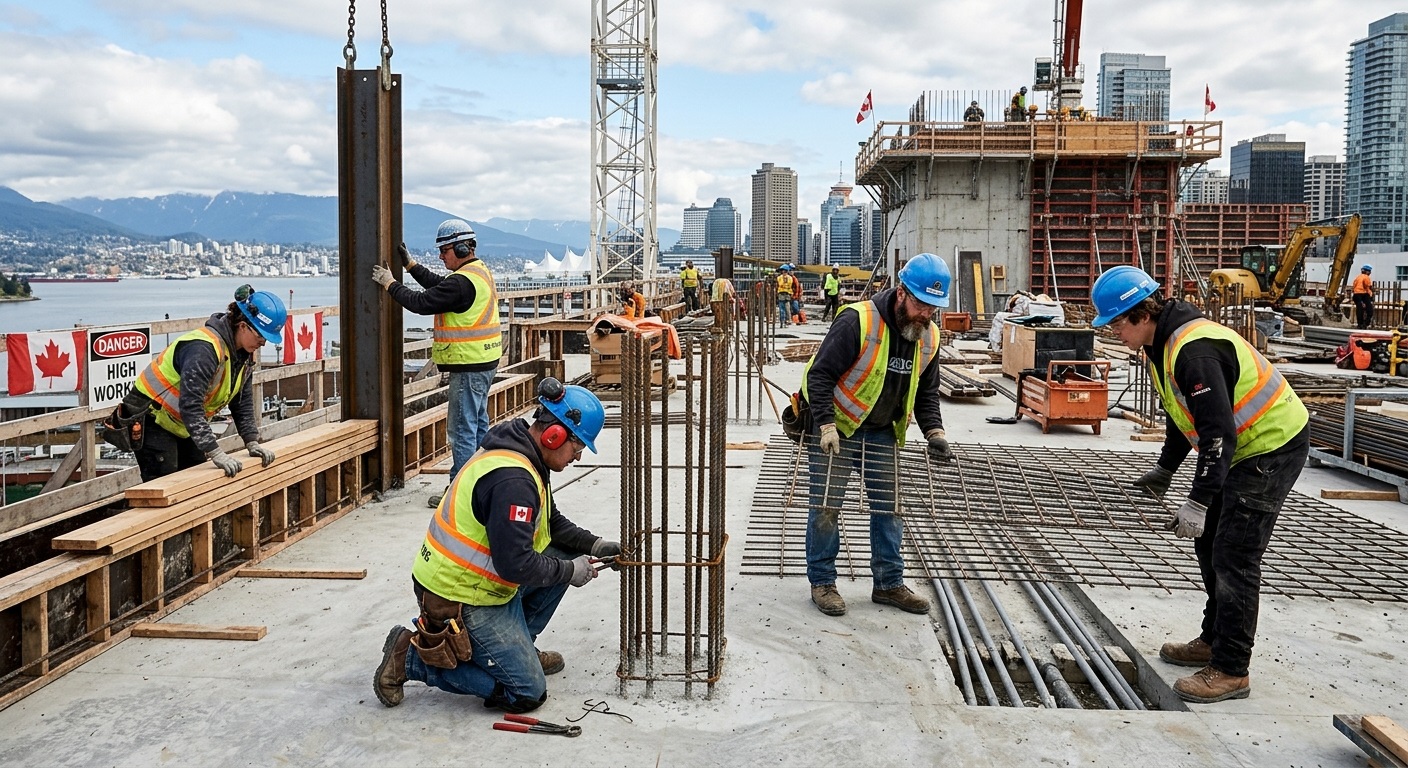
Follow these steps to make your search more effective.
Step 1: Identify suitable vacancies
Search for “construction labourer,” “construction worker,” “construction helper” and “general labourer” on Job Bank.
Use the foreign-candidate resources to identify employers that recruit internationally. Do not rely on the job title or the presence of an LMIA label alone.
Step 2: Check the eligibility conditions
Read the full vacancy, including the application deadline, required experience, education, work location and section explaining who can apply.
If you need a work permit, ask the employer whether it considers overseas applicants and whether the advertised role can support the applicable work authorisation process.
Step 3: Prepare a Canadian-style CV
Keep your CV clear and factual. Include your contact details, work experience, practical construction skills, training, safety credentials and references where appropriate.
For example, if you have experience mixing concrete, moving building materials, assisting carpenters or preparing work sites, describe those responsibilities accurately.
Step 4: Submit the application
Apply using the official Job Bank process or the employer’s verified recruitment channel. Follow the instructions and submit only the requested documents.
Step 5: Verify any offer
Confirm that the employer exists and that the person contacting you is genuinely associated with it. Check the job title, location, wage, hours, contract and work-permit arrangements.
Step 6: Complete the immigration process
If selected, follow the official Canadian immigration instructions for your circumstances. Do not travel to Canada intending to begin employment unless you have the work authorisation required for the job.
8. Common Mistakes to Avoid
Applying to every construction vacancy: Some listings are restricted to people who already have Canadian work authorisation. Check eligibility first.
Assuming an LMIA request is approval: A pending application does not guarantee a positive decision or a work permit.
Paying for a job offer: A genuine employer should not require you to purchase a job offer or pay its LMIA processing fee.
Ignoring the cost of relocation: Consider travel, accommodation, local transport and initial living expenses before accepting an offer.
Using a generic CV: Tailor your application to the duties and requirements of each vacancy.
Trusting unofficial recruiters without verification: Confirm the recruiter and vacancy through the employer’s genuine contact channels.
9. Frequently Asked Questions
1. Can I apply for construction labourer jobs in Canada from Nigeria?
Yes, you can apply for vacancies that accept international applicants. Whether you can obtain a work permit depends on the job, employer, applicable immigration route and your individual eligibility.
2. Do construction labourer jobs in Canada require a degree?
Not always. Some employers require no degree or diploma, while others prefer secondary education or relevant experience. Check the individual job advertisement.
3. Can I get an entry-level construction job without experience?
Some employers provide training and advertise positions that require no previous experience. However, entry-level status does not guarantee that an employer will recruit someone from overseas or support a work permit.
4. What is the difference between an LMIA requested and an LMIA approved job?
“LMIA requested” means the employer has applied for the assessment. “LMIA approved” means a positive decision has been issued. Neither label guarantees that a particular applicant will receive a work permit.
5. Do construction labourers need IELTS?
There is no universal IELTS requirement for every construction labourer vacancy. Employer language requirements and immigration requirements depend on the specific job and route. Do not pay for a language test unless it is required for your circumstances.
6. Can an employer pay for my accommodation and flight?
Some employers may offer relocation assistance or other benefits, but these are not guaranteed for every job. Confirm any benefits in the written employment offer.
7. Where can I find genuine construction labourer vacancies?
Start with Canada Job Bank’s Temporary Foreign Workers section and its Foreign Candidates resource. Confirm that each individual vacancy is still open and that you meet its eligibility requirements.
8. Should I pay an agent to secure an LMIA job?
Be cautious. Employers cannot recover the LMIA processing fee from temporary foreign workers, and other recruitment fees may also be prohibited. Verify any recruitment or immigration service before paying.
Conclusion
Construction labourer jobs in Canada can be worth investigating if you have the necessary practical skills, understand the work requirements and identify an employer willing to consider your circumstances.
Start with official Job Bank listings, check whether the employer accepts international applicants and confirm the applicable work permit process. An LMIA request is useful information, but it is not proof of approval or a guarantee of employment.
Prepare a clear CV, apply through genuine recruitment channels and verify every offer before spending money or making relocation plans.