
If you have experience operating excavators, bulldozers, wheel loaders, graders or other construction machinery, Canadian construction companies, excavation contractors, mining operations and infrastructure businesses may offer relevant employment opportunities.
For applicants from Nigeria, Ghana, Kenya, South Africa and other countries, the main challenge is finding an employer with a suitable vacancy that will consider an international applicant who needs permission to work in Canada.
Not every heavy equipment operator job offers visa sponsorship. Some employers require applicants to already have Canadian work authorisation, while others may consider foreign workers through an applicable immigration programme.
This guide explains the qualifications employers typically require, where to find current vacancies, how to apply and how to verify work-permit arrangements before making relocation plans.
1. What Does a Heavy Equipment Operator Do in Canada?
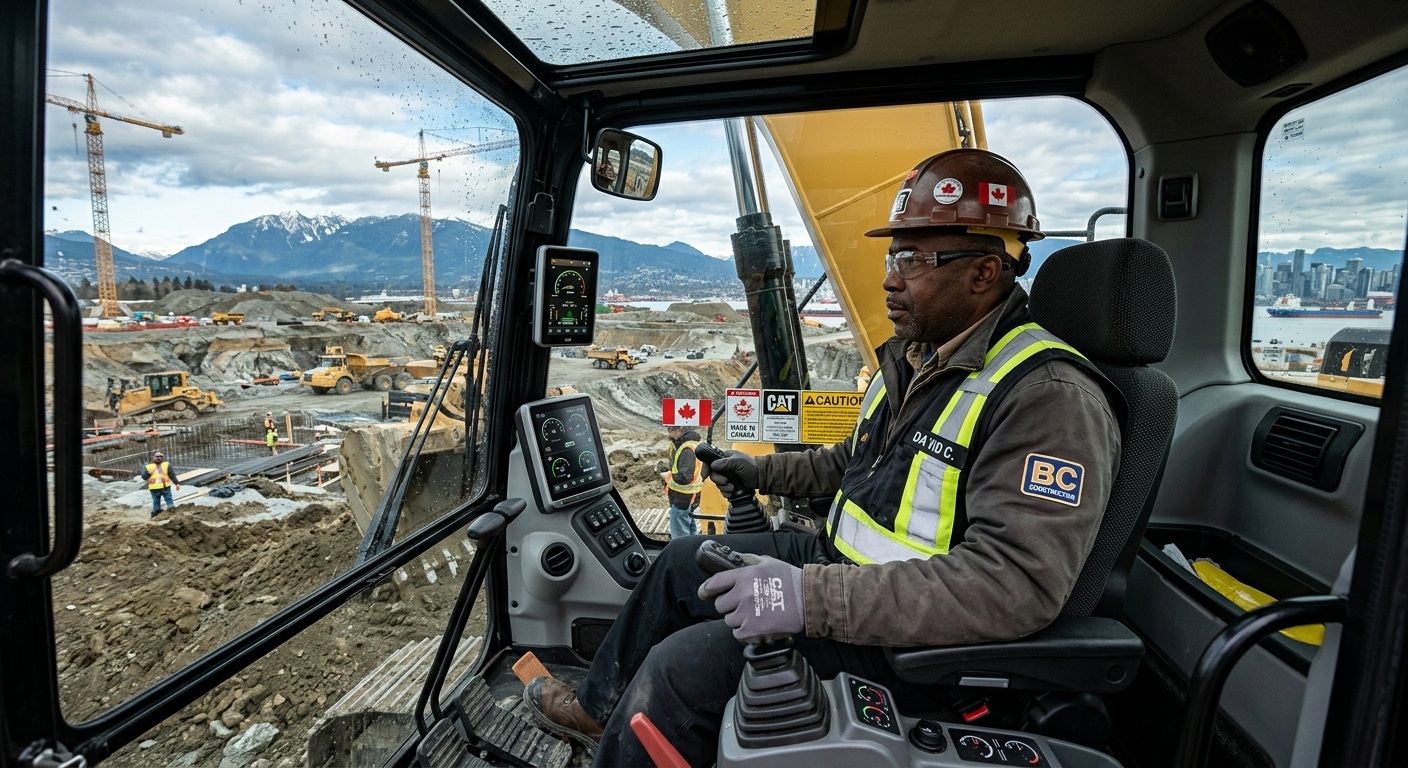
Heavy equipment operators operate machinery used in construction, excavation, road maintenance, mining, quarrying and other industrial activities.
Canada’s National Occupational Classification identifies heavy equipment operators under NOC 73400.
Depending on the job, operators may work with:
- Excavators for digging foundations, trenches and drainage systems.
- Bulldozers for moving earth and clearing construction areas.
- Wheel loaders for moving soil, gravel and construction materials.
- Motor graders for levelling and preparing road surfaces.
- Backhoes for excavation and material handling.
- Compactors and rollers for preparing roadbeds and other surfaces.
Typical responsibilities include inspecting machinery before use, operating equipment safely, following site plans, moving materials, reporting mechanical problems and completing routine maintenance checks.
Some positions involve working outdoors in difficult weather, operating machinery for extended periods and following strict safety procedures around other workers.
Official reference: Canada Job Bank — Heavy Equipment Operator Job Description.
2. Current Heavy Equipment Operator Jobs in Canada
Canada Job Bank is a useful starting point for finding current equipment-operator vacancies. Its listings include jobs posted directly by employers, as well as positions associated with temporary foreign-worker recruitment.
The following advertisements appeared in Job Bank search results on October 17, 2026.
| Job title | Employer | Location | Advertised pay | Foreign-worker status |
|---|---|---|---|---|
| Heavy Equipment Operator | Gateway Landscaping & Excavating | Vancouver, British Columbia | CAD $38.50/hour | Current listing identified; overseas eligibility and sponsorship not confirmed. |
| Equipment Operator, Heavy-Duty | Pioneer Construction Inc. | Copper Cliff, Ontario | CAD $28.85/hour | Current listing identified; LMIA and overseas applicant eligibility need checking. |
| Heavy-Duty Equipment Operator | T.K.’s Trucking Ltd. | Clarenville, Newfoundland and Labrador | CAD $30/hour | Current listing identified; work-permit support not confirmed. |
| Heavy Equipment Operator | Air and Oceanland Inc. | Brampton, Ontario | CAD $37–$40/hour | Current listing identified; confirm whether international applicants are eligible. |
| Heavy Equipment Operator | Earthco Soil Mixtures Inc. | Concord, Ontario | CAD $37/hour | Current listing identified; sponsorship not confirmed. |
Official vacancy links
- Gateway Landscaping & Excavating — Heavy Equipment Operator
- Pioneer Construction Inc. — Equipment Operator, Heavy-Duty
- T.K.’s Trucking Ltd. — Heavy-Duty Equipment Operator
- Air and Oceanland Inc. — Heavy Equipment Operator
- Earthco Soil Mixtures Inc. — Heavy Equipment Operator
If a vacancy has expired or its link no longer works, search the employer’s name and job title through Canada Job Bank or the employer’s official recruitment website.
How to identify a genuine opportunity for foreign workers
Open the advertisement and read the section explaining who can apply. If the employer only accepts applicants who already have Canadian work authorisation, the vacancy may not be suitable for someone applying from overseas without a permit.
Look for an explicit statement that international applicants may apply, and ask the employer whether it can support the applicable work permit process.
An LMIA request, where one is mentioned, does not establish that the assessment has been approved. It also does not guarantee that a work permit will be issued.
3. Heavy Equipment Operator Requirements in Canada
The requirements for heavy equipment operator jobs vary by employer, province, machinery type and project.
According to Canada Job Bank’s occupational guidance for NOC 73400, typical requirements include some secondary school education and relevant training, such as an apprenticeship, industry courses or on-the-job training.
Education and technical training
Some employers expect a high school education or equivalent. Training may be obtained through a recognised heavy equipment operating programme, apprenticeship or a combination of relevant courses and supervised practical experience.
If you trained outside Canada, keep copies of your certificates and records of the equipment you learned to operate.
Operating experience
Many employers prefer candidates who have practical experience operating machinery safely and efficiently.
Experience with an excavator is not automatically equivalent to experience with a bulldozer, grader or specialised industrial machine. Specify the equipment you have operated and the type of projects you have worked on.
Certification and licensing
Certification requirements vary by province and equipment type. Job Bank indicates that heavy equipment operator trade certification is compulsory in Quebec for specified equipment categories, while certification is available but voluntary in certain other provinces.
Some employers may also require internal equipment certification, site safety training or additional qualifications.
Before accepting a position, check the relevant provincial authority to establish whether your foreign training or experience needs to be assessed.
Official reference: Job Bank — Heavy Equipment Operator Requirements.
Safety knowledge
Employers may expect operators to understand equipment inspections, load limits, safe manoeuvring, site traffic rules and the risks associated with working near other machinery and personnel.
Depending on the job, additional training may be required for particular equipment, work environments or site procedures.
4. Where Can Heavy Equipment Operators Work in Canada?
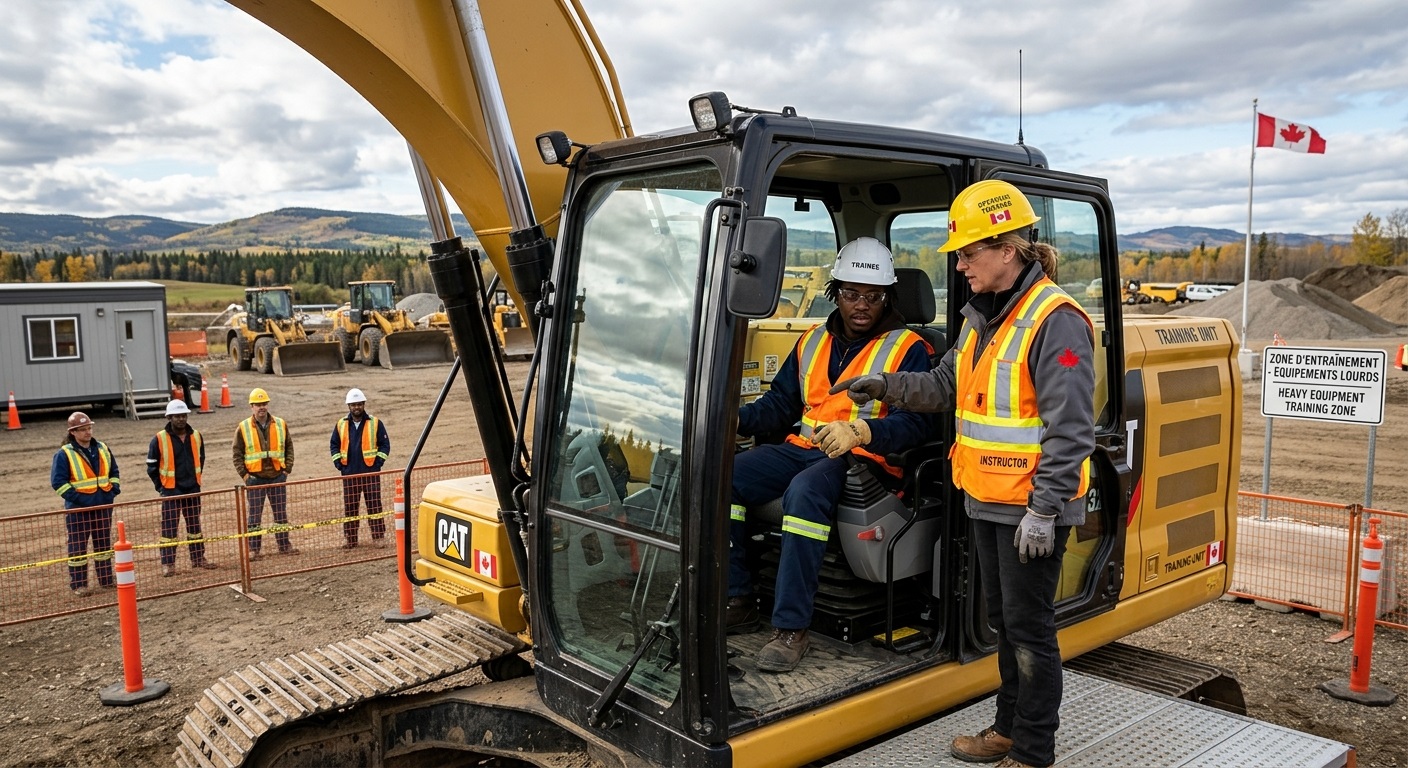
Heavy equipment operators are employed in several industries. Your best opportunities will depend on your experience, the machinery you can operate and the employers recruiting in your preferred location.
Construction and excavation: Contractors use operators to prepare sites, dig foundations, move earth and support building projects.
Roads and infrastructure: Road construction, bridge projects and public works may require graders, rollers, excavators and other equipment.
Mining and quarrying: Some operations require specialised machinery and relevant industrial experience. Requirements can be more demanding than those for general construction work.
Landscaping and earthworks: Operators may prepare land, move soil, grade surfaces and support drainage or outdoor development projects.
Industrial and material handling: Some employers use heavy machinery to move materials, prepare work areas or support industrial operations.
Search by both job title and equipment type. For example, use “excavator operator,” “bulldozer operator,” “grader operator” or “wheel loader operator” instead of relying only on the general phrase “heavy equipment operator jobs in Canada.”
5. Canadian Employers to Investigate
Alongside individual job advertisements, you can research established contractors and infrastructure businesses through their official websites.
These are additional employers to investigate, not a claim that they currently offer visa sponsorship for every position.
PCL Construction
Official website: PCL Construction Careers
PCL works across commercial construction, industrial projects and civil infrastructure. Search its vacancies for equipment-related positions, construction operations and relevant site roles.
Check the qualifications, work location and employment conditions for each vacancy. Do not assume that a general international recruitment page confirms sponsorship for a particular equipment operator position.
Aecon Group Inc.
Official website: Aecon Careers
Aecon operates across infrastructure, transportation, utilities and other construction-related sectors. Its recruitment portal is worth checking for equipment-related work and other positions that match your qualifications.
Verify the work-permit arrangements directly with the employer if you need immigration support.
Ledcor
Official website: Ledcor Careers
Ledcor operates in construction and infrastructure-related industries. Search for equipment operator and related field positions that match your experience.
Confirm whether the specific job is open to international applicants and whether the employer will consider candidates who require work authorisation.
How to verify an employer
Before sending sensitive documents, confirm that the employer’s website is genuine, the vacancy appears on its official recruitment portal or a credible employment platform, and the person contacting you is authorised to recruit for the company.
A genuine company’s name can be copied by a scammer. Verify the specific job offer, not just the company’s existence.
6. Can Foreign Workers Get Heavy Equipment Operator Jobs in Canada?
Yes, eligible foreign workers may be hired for heavy equipment operator positions, but they must satisfy both the employer’s requirements and the applicable immigration rules.
The main considerations are:
- Whether the employer is willing and able to hire an international applicant.
- Whether the job meets the requirements of the applicable work permit programme.
- Whether an LMIA is required for that position.
- Whether the applicant meets the relevant immigration and documentation requirements.
- Whether the worker has the required qualifications, experience and any applicable certification.
Understanding LMIA construction jobs
A Labour Market Impact Assessment is an assessment used under Canada’s Temporary Foreign Worker Program.
Where an LMIA is required, the employer generally must obtain the necessary positive decision before the foreign worker can use it to support an employer-specific work permit application.
A job advertised as “LMIA requested” has not necessarily received approval. A positive LMIA also does not guarantee that the worker’s application will be approved.
Some workers may qualify under other work permit pathways that do not require an LMIA. The appropriate process depends on the worker’s circumstances and the position.
Official resources:
Who pays the LMIA fee?
The employer is responsible for the LMIA processing fee where one applies and must not recover that fee from the temporary foreign worker.
Be cautious if a recruiter asks you to purchase an LMIA, pay for a guaranteed job offer or transfer money to secure a Canadian work permit.
7. How Much Do Heavy Equipment Operators Earn in Canada?
Pay varies according to the province, employer, machinery type, work schedule, experience and industry.
The five vacancies identified above advertised hourly rates ranging from CAD $28.85 to CAD $38.50, with one listing offering CAD $37–$40 per hour. These figures describe the particular advertisements, not a guaranteed wage for every operator or a national average.
When comparing jobs, consider:
- The hourly rate and expected weekly hours.
- Whether overtime is available and how it is paid.
- Whether the job is seasonal, permanent or contract-based.
- Whether accommodation, transport or relocation assistance is included in writing.
- The cost of living in the location.
- Whether you need additional certification or equipment training.
Use Canada Job Bank’s heavy equipment operator wage information to investigate wages by location.
Do not assume that a higher advertised wage means the employer will sponsor a foreign worker.
8. How to Apply for Heavy Equipment Operator Jobs From Abroad
Step 1: Identify your strongest equipment skills
List the machinery you can safely operate, your training and the projects you have worked on. Focus on positions that match your actual experience.
Step 2: Search official vacancy portals
Use Canada Job Bank and the employer career pages listed in this guide.
Search using terms such as “excavator operator,” “heavy-duty equipment operator,” “grader operator” and “bulldozer operator.”
Step 3: Review the eligibility conditions
Read the full vacancy and check who can apply. If you need a work permit, ask the employer whether it considers applicants living outside Canada and whether it can support the applicable process.
Step 4: Prepare a targeted CV
Include your work history, machinery experience, technical training, safety qualifications and relevant project experience.
For example, state the types of excavators or loaders you have operated, the tasks you performed and the duration of your experience. Avoid vague statements such as “I can operate all machines” unless they are accurate and supported by your experience.
Step 5: Apply through the official channel
Follow the instructions on the employer’s website or the verified job advertisement. Submit accurate information and the documents requested.
Step 6: Verify the job offer
Confirm the vacancy, employer, location, pay, contract terms and work-permit arrangements. Never rely solely on a social media message or an offer letter carrying a company logo.
Step 7: Follow the correct immigration process
If an employer selects you, obtain the necessary documentation and follow the relevant Canadian immigration instructions. Do not begin employment until you have the work authorisation required for the job.
9. Common Mistakes to Avoid
Assuming every equipment operator vacancy offers sponsorship. Most advertisements do not automatically establish overseas eligibility.
Confusing an LMIA request with approval. A requested or pending LMIA is not a positive decision.
Applying without the necessary skills. Operating heavy machinery can involve significant safety risks, and employers may require practical experience or specific certification.
Ignoring provincial requirements. Certification rules differ by province and equipment category.
Paying for a guaranteed job offer. Be suspicious of demands for money to purchase an LMIA or guarantee a work permit.
Failing to verify recruitment contacts. Contact the employer through independently verified channels before sharing sensitive documents or making financial commitments.
10. Frequently Asked Questions
1. Can I apply for heavy equipment operator jobs in Canada from Nigeria?
Yes, you can apply for positions that accept international candidates. Whether you can obtain a work permit depends on the employer, job, applicable immigration route and your eligibility.
2. What qualifications do heavy equipment operators need in Canada?
Typical requirements include some secondary school education, relevant training and practical operating experience. Certification requirements depend on the equipment, province and employer.
3. Are there excavator operator jobs in Canada for foreign workers?
Excavator operator vacancies may be advertised by construction and excavation companies. You must verify that the individual employer accepts overseas applicants and can support the relevant work authorisation where required.
4. Do heavy equipment operators need Canadian certification?
Not always. Requirements vary by province, equipment category and employer. Some positions require specific certification or training, so check the rules for the job location before accepting an offer.
5. Does an LMIA guarantee a Canadian work permit?
No. A positive LMIA may support a work permit application, but the applicant must still meet the applicable immigration requirements and receive the required approval.
6. How can I find genuine heavy machinery operator jobs?
Start with Canada Job Bank and official employer career portals. Confirm the live vacancy, applicant eligibility, qualifications and recruitment contact before applying.
7. Can an employer pay for flights or accommodation?
Some employers may offer relocation assistance, accommodation or travel benefits, but these are not guaranteed. Confirm all promised benefits in the written contract.
8. Should I pay an agent to obtain a heavy equipment operator job?
Be cautious. Employers cannot recover the LMIA processing fee from temporary foreign workers, and other recruitment fees may also be prohibited. Verify the legitimacy of any service before paying.
Conclusion
Heavy equipment operator jobs in Canada can be worth exploring if you have the right training, practical experience and qualifications for the machinery involved.
Start with official job listings, identify employers that match your experience and confirm whether each vacancy accepts international applicants. Check provincial certification rules, understand the applicable work permit process and verify the employer before making relocation plans.
The most important step is to distinguish a genuine vacancy from a confirmed foreign-worker opportunity. A current job advertisement is a useful starting point, but it is not proof of visa sponsorship or guaranteed work permit approval.